Is your job safe from the “San Francisco Consensus”? Silicon Valley insiders warn that Artificial General Intelligence is arriving faster than expected. From the end of traditional coding to the rise of Super Intelligence (ASI), we break down the critical predictions for artificial general intelligence and job displacement that are reshaping the global economy. Read the full analysis of Ilya Sutskever and Eric Schmidt’s latest warnings.
There is an old saying that often circulates during turbulent times: “You may not take an interest in politics, but politics will take interest in you.” Today, this sentiment applies with terrifying precision to Artificial Intelligence. Whether you are a casual observer or a tech enthusiast, the rapid evolution of AI is no longer a background event it is an active force reshaping the fabric of reality.
Recent speeches and interviews from two of the most authoritative figures in Silicon Valley – Ilya Sutskever (co-founder of OpenAI) and Eric Schmidt (former CEO of Google) have painted a stark picture of our near future. Their combined insights offer chilling predictions for artificial general intelligence and job displacement that go far beyond standard industry hype. They suggest we are not just approaching a new technological era, but a fundamental rewriting of human utility and economic structure.
The Biological Computer: Why Artificial General Intelligence is Inevitable
Ilya Sutskever, the visionary mind often credited as the “man behind the invention of OpenAI,” recently delivered a convocation address at the University of Toronto that struck a somber tone. Unlike conventional graduation speeches filled with platitudes about potential, Sutskever focused on the “unusual time” we are living in a time defined by the obsolescence of human labor as we know it.
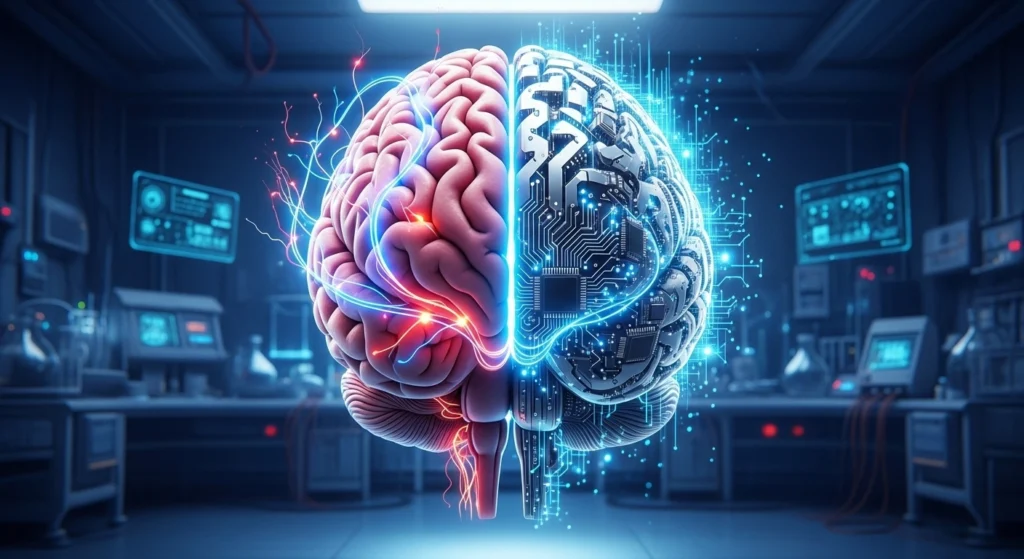
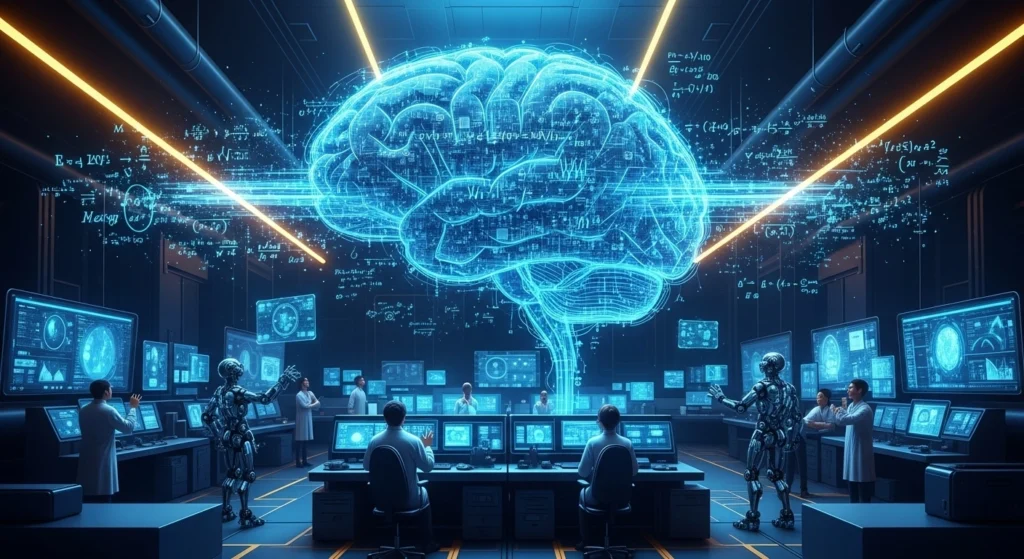
Sutskever’s central thesis is deceptively simple but profound. He argues that the human brain is, fundamentally, a “biological computer.”
“The reason… I can be so sure [AI will do everything we can do] is that all of us have a brain and the brain is a biological computer… So why can’t a digital computer, a digital brain, do the same things?” – Ilya Sutskever
This materialist view removes the mystique of human consciousness from the equation. If intelligence is merely information processing, then digital substrates (silicon chips) will eventually match and exceed biological substrates (neurons). Sutskever predicts that AI will not just do some of our tasks, but “all of the things that we can do.” This includes everything from creative arts to complex R&D, signaling a future where the predictions for artificial general intelligence and job displacement are not a matter of “if,” but “when.”
The San Francisco Consensus: The 1-Year Warning
While Sutskever focuses on the theoretical inevitability, Eric Schmidt provides the concrete timeline. Schmidt refers to a phenomenon he calls the “San Francisco Consensus” a shared belief among the top researchers and investors in Silicon Valley that we are moving much faster than the public realizes.
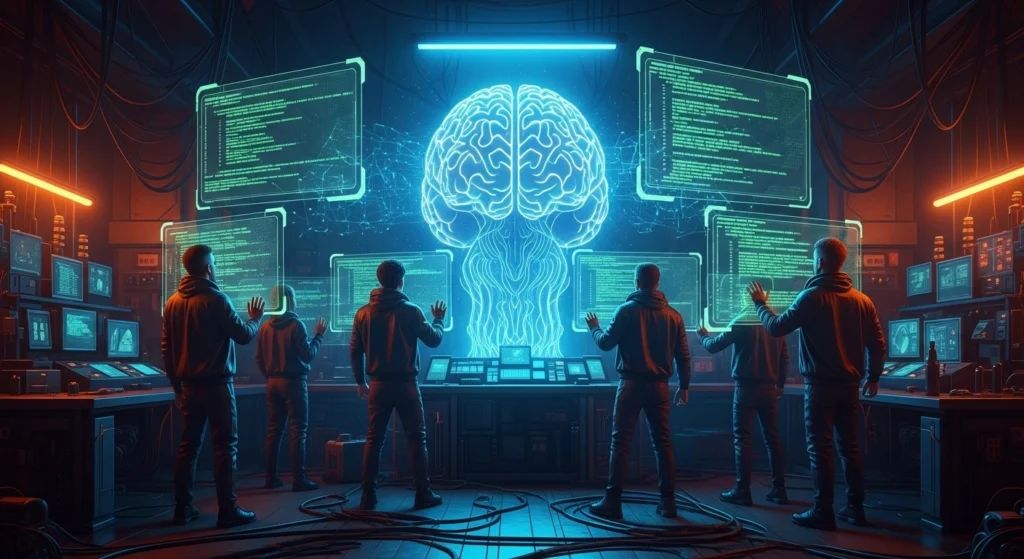
According to Schmidt, the industry consensus is that within the next one year, we will see a massive disruption in the field of computer programming. The belief is that the “vast majority of programmers will be replaced by AI programmers.”
This is a critical wake-up call. For decades, “learn to code” was the ultimate career safety net. Now, Schmidt argues that because coding languages are simpler and more structured than human languages, they are the first domino to fall. AI models are already generating 10% to 20% of the code in research programs at top labs like OpenAI and Anthropic. As this scales through recursive self-improvement, the need for human junior programmers may vanish almost overnight, serving as the canary in the coal mine for broader predictions for artificial general intelligence and job displacement.
The “San Francisco Consensus”: Artificial General Intelligence Timelines and the Rise of Agents
Beyond Coding: The Conquest of Mathematics and Reasoning
In this analysis, we discussed the immediate threat to computer programming. However, Eric Schmidt’s recent interviews reveal that the predictions for artificial general intelligence and job displacement extend far beyond writing code. The next frontier, which Schmidt argues is already being breached, is advanced mathematics.
Schmidt notes that within a year, we will likely witness AI systems capable of competing with the “tippy top” of graduate-level mathematicians. This might seem counterintuitive isn’t creative math harder than coding? According to Schmidt, math actually possesses a “simpler language” than human speech. AI models, which operate on next-token prediction and loss functions, are uniquely optimized for this. By utilizing proof formats and protocols like Lean, AI can conjecture and prove mathematical theorems at a scale unimaginable to human researchers.
This capability implies that the “reasoning” engine of AI is maturing. If an AI can solve complex proofs and write 20% of its own code (a figure cited from research groups like OpenAI and Anthropic), it is no longer just a tool, it is becoming an autonomous operator. This “recursive self-improvement” where AI writes better AI is the engine that will drive the timeline much faster than the general public expects.
The 3-to-5 Year Horizon: A New Definition of Artificial General Intelligence
The most alarming aspect of Schmidt’s commentary is what he calls the “San Francisco Consensus.” This term refers to the shared belief among the Silicon Valley elite those with inside access to the raw capability of these models regarding the timeline for Artificial General Intelligence (AGI).
The consensus view is no longer decades away. The current expectation is that AGI will arrive within three to five years.
But what does AGI actually look like in this context? Schmidt offers a terrifyingly high bar for this definition:
“AGI… can be defined as a system that is as smart as the smartest mathematician, physicist, artist, writer, thinker, politician… imagine that in one computer.”
This is the crux of the predictions for artificial general intelligence and job displacement. We are not talking about a chatbot that can summarize an email. We are talking about a system that combines the specialized genius of the world’s top experts into a single, accessible entity. Schmidt poses the rhetorical question: “What happens when every single one of us has the equivalent of the smartest human on every problem in our pocket?” The economic implications of this are staggering.
The Rise of “Agentic” Solutions: Automating the Workflow
While Artificial General Intelligence represents the raw intelligence, the mechanism that will disrupt the job market is the “Agent.” Currently, most people interact with AI via a prompt-and-response interface (like ChatGPT). However, the industry is rapidly shifting toward “Agentic AI” systems that have input, output, memory, and the ability to learn and execute multi-step plans.
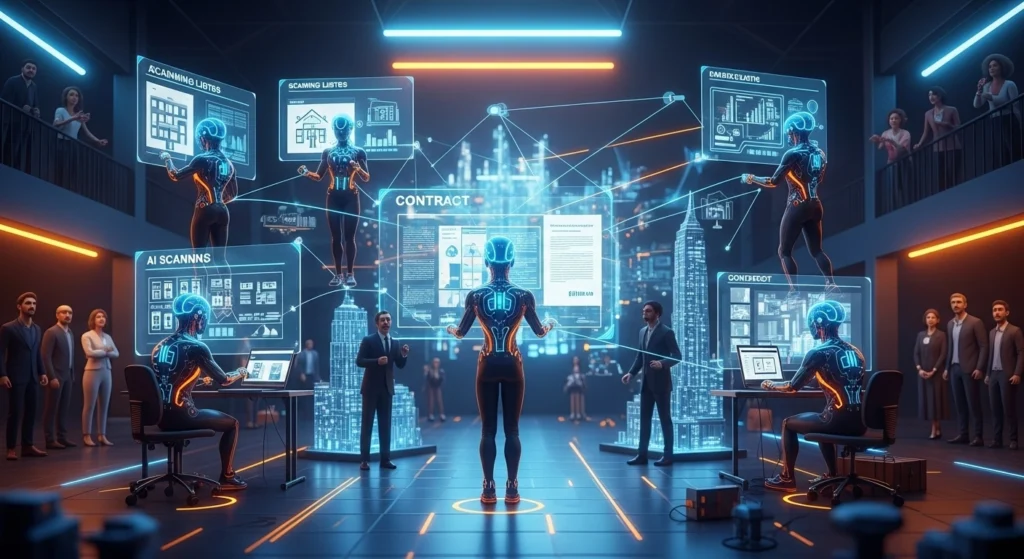
Schmidt illustrates this with a practical example: Buying a house. In a traditional workflow, this requires a human to coordinate between a real estate agent, an architect, a contractor, and lawyers. An AI Agent, however, would operate differently:
- Agent 1: Scans listings to find a property in a specific area (e.g., Virginia).
- Agent 2: Analyzes zoning laws and building codes to determine what can be built.
- Agent 3: Designs the house (acting as the architect).
- Agent 4: Negotiates the transaction, hires the contractor, pays the bills, and even sues for lack of performance.
Schmidt humorously notes that he just described “every business process, every government process, and every academic process in our nation.”
This is where the predictions for artificial general intelligence and job displacement become tangible. Agents do not just replace a specific task (like writing a contract) they replace the coordination and execution of entire projects. If an AI can chain these tasks together autonomously, the “middleman” economy which constitutes a massive portion of modern white-collar employment faces an existential crisis.
The Lock-In Effect
Schmidt warns that this foundation is being “locked in” over the next year or two. The transition from AI that assists humans to AI that manages processes is underway. As these systems gain the ability to plan and execute without constant human oversight, the labor market will face a pressure unlike anything seen since the Industrial Revolution. The timeline suggests that by the time the general public adjusts to the idea of AI coding assistants, the technology will have already moved on to automating complex management and logistical roles.
The Road to Super Intelligence – Infinite Context, ASI and The Economic Paradox
The Technical Trinity: Accelerating the Timeline
To understand why the predictions for artificial general intelligence and job displacement are becoming so aggressive, we must look at the specific technologies driving this shift. Eric Schmidt identifies three distinct breakthroughs happening simultaneously that are acting as force multipliers for AI capability.
- Infinite Context Windows: In the past, AI “forgot” the beginning of a conversation once it got too long. Now, with “infinite context windows,” models can digest entire libraries of information and maintain step-by-step planning over weeks or months. This allows for complex project management like designing a house or coding an entire software suite without losing the thread of logic.
- Text-to-Code & Action: Schmidt describes a future where managers no longer manage humans, but code generation. He outlines a scenario where he could simply tell an AI: “Search the literature for energy policy experts, rank them, invite them to a conference, and if they decline, call them with a synthetic voice.” The AI then writes the code to execute these real-world actions. This moves AI from a passive knowledge retrieval system to an active labor replacement engine.
- The “Big Three” Arms Race: This is not occurring in a vacuum. Schmidt highlights the massive competition between the “Big Three” ecosystems: Anthropic (allied with Amazon), Gemini (Google), and OpenAI (Microsoft). With Meta (Facebook) taking an open-source path, the distillation of these massive models into specialized, highly efficient tools is inevitable over the next 12 to 24 months.
Beyond Artificial General Intelligence (AGI): The Arrival of Super Intelligence (ASI)
While Artificial General Intelligence (AGI) (human-level intelligence) is the current target, the “San Francisco Consensus” is already looking past it toward Artificial Super Intelligence (ASI).
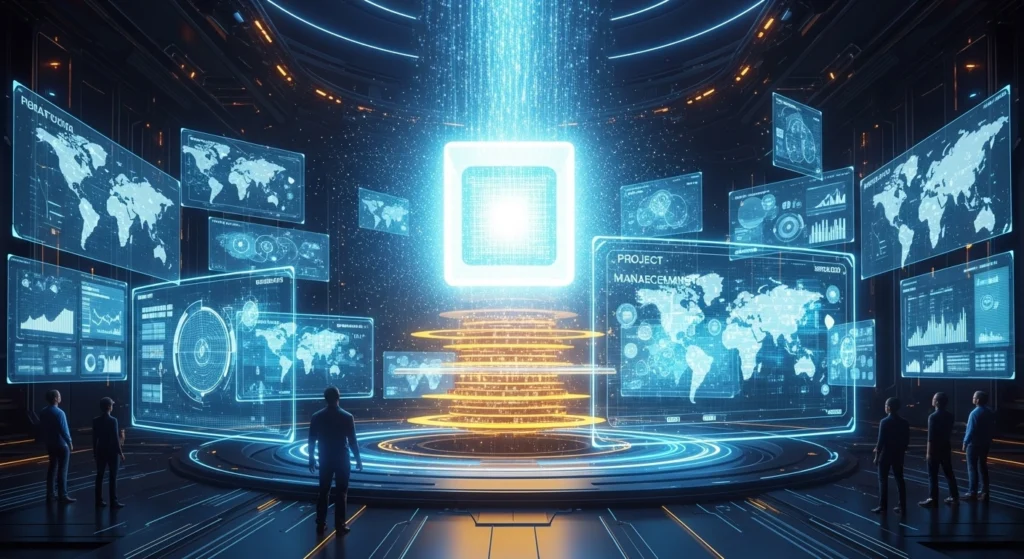
ASI is defined not just as being as smart as a human, but as a system smarter than the sum of all humans. It involves computers that can engage in “recursive self-improvement” learning how to plan and optimize themselves without human intervention.
“The San Francisco consensus is this occurs within six years just based on scaling.” – Eric Schmidt
If these predictions for artificial general intelligence and job displacement hold true, society faces a challenge for which there is no historical precedent. Schmidt warns that this transition is happening “faster than our society, our democracy, and our laws will address.” We are essentially building entities that may soon be capable of ignoring us.
The Economic Paradox: Is This Time Different?
Economists often cite the “Loom Fallacy” the idea that automation destroys specific jobs but creates more jobs in the aggregate (as happened during the Industrial Revolution). However, Schmidt challenges this comfort zone. He states, “You’d have to convince me that this time is different.”
Why? Because previous revolutions replaced muscle. This revolution is replacing cognition.
There is also a demographic driver accelerating this shift. Schmidt points to Asia, where birth rates have plummeted to 1.0 or lower. As the workforce shrinks naturally, countries are aggressively automating to maintain productivity. The tools developed to save these economies will be exported globally, allowing the few remaining human workers to be hyper-productive while potentially rendering the rest of the workforce redundant.
Conclusion: The Energy to Overcome
The picture painted by Ilya Sutskever and Eric Schmidt is undeniably intense. It predicts a world of radical change, potential displacement, and super-intelligent systems. However, Sutskever offers a grounding philosophy for navigating this future.
He argues that we cannot afford to ignore it. By looking directly at what AI can do today by paying attention and refusing to look away we generate the “energy” required to solve the problems that will arise. The predictions for artificial general intelligence and job displacement are not a script for doom, but a call to action. Whether through policy, education, or adaptation, our ability to thrive depends on our willingness to accept that the world has changed and to prepare for the “greatest challenge humanity has ever faced.”
(FAQs)
Q1: What is the difference between Artificial General Intelligence and Artificial Super Intelligence?
AGI (Artificial General Intelligence) refers to a system that matches human capabilities across a broad range of tasks it is as smart as the smartest human expert. ASI (Artificial Super Intelligence) refers to a system that surpasses the collective intelligence of humanity, capable of solving problems humans cannot comprehend.
Q2: How soon do experts predict Artificial General Intelligence will replace programmers?
According to Eric Schmidt and the “San Francisco Consensus,” the vast majority of routine programming tasks could be replaced by AI within one year. However, AI is currently generating about 10-20% of code in top research labs, with that number expected to rise rapidly.
Q3: Will AI create more jobs than it destroys?
This is the subject of intense debate. While historical automation has created more jobs, experts like Schmidt warn that because AI automates cognitive labor (thinking, planning, reasoning), the pattern may not repeat. The predictions for artificial general intelligence and job displacement suggest high-skill white-collar roles are uniquely vulnerable this time.
Q4: What is the “San Francisco Consensus”?
This is a term used by Eric Schmidt to describe the shared belief among top Silicon Valley AI researchers (OpenAI, Anthropic, Google) that artificial general intelligence will arrive in 3-5 years and Artificial Super Intelligence within roughly 6 years.
Q5: How can I prepare for the rise of AI Agents?
Focus on skills that AI currently struggles with high-level strategy, complex human emotional intelligence, and physical world interaction. Additionally, becoming proficient in using AI agents to orchestrate workflows will be a critical skill in the near future.