

Unlock the definitive 5-stage roadmap for scaling your e-commerce presence from a simple side hustle to an exit-ready brand. This expert-led, comprehensive guide, built on experience and original research, is specifically tailored for entrepreneurs aiming to build a robust Shopify business in 2026. It reveals the exact sequence of skills and models required to transform basic revenue streams into a highly sellable e-commerce asset. We detail the crucial transition points:
- Phase 1 (Learn): Mastering traffic, tech, and compelling offers using low-risk models like dropshipping.
- Phase 3 (Own): Establishing your brand and supply chain through white labeling, which requires advanced skills in negotiation and forecasting.
- Phase 5 (Exit): The strategic brand-building stage, where you implement high-level strategies in team scaling, expansion, and valuation.
This article provides the trusted, step-by-step solutions to overcome the “Cash Flow Dip” and implement the proprietary moat (R&D, Unit Economics) necessary for maximum valuation. Stop chasing trends, start creating a powerful, independent asset structured for acquisition and sustainable wealth generation in the modern e-commerce landscape.
From Side Hustle to Wealth: The Entry-Level Foundation
The landscape of digital commerce is shifting rapidly. If you are looking to start or scale a Shopify business in 2026, the goalposts have moved. It is no longer enough to simply “make money online” or generate a passive income stream. The true path to wealth and the strategy used by the top 1% of entrepreneurs is building a business that works for you.
Whether you are currently running a side hustle you want to take full-time, or you are already managing a bustling store, the ultimate objective should be turning your operation into a sellable e-commerce asset. This is an asset that generates cash flow while you sleep and eventually provides a massive payday when you exit.
In this comprehensive guide, we are going to break down the five distinct stages of growing an e-commerce business. This isn’t theoretical fluff; this framework is built on the reality of trying every model imaginable, from dropshipping and reselling to white labeling and building proprietary brands. By following this roadmap, you can navigate from the “Entry Level” all the way to the “Exit Level.”
The 5-Stage Roadmap to E-Commerce Success
To build a successful Shopify business in 2026, you must understand where you sit on the growth curve. Most entrepreneurs fail because they try to jump straight to the finish line without mastering the foundational skills of the earlier stages. Imagine an axis where one line represents Cash (income) and the other represents Time/Stages.
- Stage 1 (Entry): You enter the market. Income is often low, but skill acquisition is high.
- Stage 5 (Exit): You exit the market by selling your sellable e-commerce asset for a multiple of its revenue.
The journey between these two points involves a “scoop” in income. You might start low, rise up, dip slightly as you reinvest in your own products, and then experience a “hockey stick” growth curve toward the end. The danger zone is the middle, where income stagnates or drops during reinvestment, causing many to quit just before they strike gold. Let’s begin where everyone starts: The Entry Level.

Stage 1: The Entry Level (The “Learn” Phase)
For most people, the entry into the world of e-commerce begins with a side hustle. This is often the phase where you are working a full-time job and trying to figure out how the internet money machine works. The most common model at this stage is dropshipping.
If you are unfamiliar with the term, dropshipping is a fulfillment method where a store doesn’t keep the products it sells in stock. Instead, when a store sells a product using the dropshipping model, it purchases the item from a third party (a supplier) and has it shipped directly to the customer. So the seller avoids inventory management and product handling entirely.
The Reality of Dropshipping in 2026
In the context of a Shopify business in 2026, dropshipping remains a viable entry point, but it is rarely the endgame.
- The Pro: You don’t need capital for stock. You pay the supplier after receiving payment from the customer, reducing upfront costs. This makes it a low-risk environment to test the waters.
- The Con: Your margins are incredibly thin. Furthermore, you have zero control.
A real-world example is the massive online trend around AirPod cases. Years ago, you could sell silicone cases for AirPods for $30 or $40 while buying them for $1. It was a goldmine until it wasn’t. Because you don’t own the product, the supplier can sell that same item to thousands of other merchants. Suddenly, competitors flood the market, prices drop to $9, and your profit evaporates overnight.
However, you should not skip this stage. While it may not make you a millionaire, it provides the essential education required to build a sellable e-commerce asset later.
The 3 Core Skills You Must Master in Stage 1
If you are running a dropshipping store today, do not focus solely on the profit. Focus on the skills. You are in the “Learn Phase.” To succeed in a Shopify business in 2026, you must master these three pillars during Stage 1:
1. Driving Traffic (The Lifeblood) If you cannot get eyeballs on your website, you do not have a business. You must learn the art of paid ads (Meta, TikTok, Google) and organic reach. Without traffic, even the best product in the world will fail.
2. Technical Competence (The Tools) You need to become fluent in the tech stack. How do you build a high-converting Shopify store? How do you integrate it with eBay or Amazon? How do you set up email flows? These technical hurdles are the “tuition” you pay in Stage 1.
3. The Offer (The Differentiator) This is arguably the most critical skill. In a dropshipping model, you are selling the same product as everyone else. Why should a customer buy from you? You must learn to craft a compelling offer. This involves bundling, copywriting, and positioning your product in a way that makes it irresistible.
Key Takeaway: In Stage 1, you are not building a long-term asset yet. You are being paid to learn. You are acquiring the skills of traffic, tech and offers that will serve as the foundation for the next stages.
The Problem with Staying in Stage 1
While dropshipping is a fantastic training ground, it has a fatal flaw: Lack of Control.
Your business depends entirely on the reliability of your suppliers and shipping partners. If your supplier runs out of stock or decides to stop manufacturing a product, as often happens with trending items like smartwatches or gadgets, you are left with angry customers and refunds to process. You cannot build a sellable e-commerce asset if you do not own the supply chain or the brand equity.
To move from a hustler to a business owner, you must graduate to Stage 2: Reselling. This is where you take the skills you learned in Stage 1 and apply them to proven products with existing demand.

Stage 2: The Reselling Model (The “Upgrade” Phase)
As we transition from the entry-level “Learn” phase, we move into the territory where real revenue often begins to materialize. This is the Reselling Model, and for many entrepreneurs, this is where they make their first significant profit, sometimes even their first million.
In a mature Shopify business in 2026, reselling differs fundamentally from dropshipping. Instead of testing unproven gadgets, you are selling products that already possess brand equity and proven market demand.
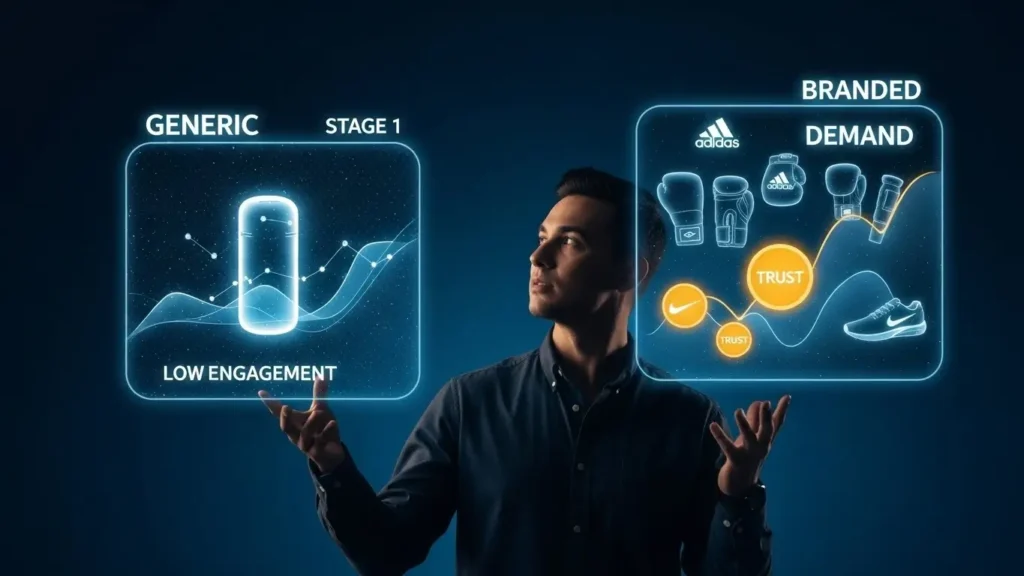
Think of it this way: In Stage 1, you were trying to convince people to buy a generic product they had never heard of. In Stage 2, you are selling products people already want. In my own journey, this manifested as selling martial arts equipment, boxing gloves, and gear from established heavyweights like Adidas and Nike.
Why Reselling Works
The advantage here is speed and trust. The market already trusts the brand; you just need to be the preferred conduit for that purchase. You take the traffic generation and technical skills you mastered in Stage 1 and apply them to high-demand inventory.
However, to succeed with this model in a competitive Shopify business in 2026, you must master three new, critical skills that were unnecessary in dropshipping.
1. Cash Flow Management
This is the biggest shock for new entrepreneurs. In dropshipping, you have a positive cash flow cycle (customer pays you, dollar for dollar, you pay the supplier). In reselling, you must buy the stock upfront. You are investing capital into inventory before a single sale is made.
This shift teaches you the discipline of cash flow. You don’t need to hoard massive warehouses of stock; suppliers hold the bulk, but you must purchase small quantities to fulfill orders yourself. You learn to balance your bank account against your inventory levels to remain profitable.
2. Merchandising Strategy
Since other stores are likely selling the same adidas boxing glove, why should a customer buy from you? This is where Merchandising comes in.
You must learn how to present the product better than the competition. This involves superior product photography, better descriptions, bundling related items, and creating a user experience on your site that outshines the rest. In the landscape of a Shopify business in 2026, if your merchandising is weak, you will lose to Amazon.
3. Logistics and Fulfillment
Welcome to the world of physical labor. Unlike dropshipping, where the supplier handles the box, reselling often starts in your garage. You will learn how to print labels, pack boxes efficiently, negotiate with couriers, and manage returns. While this sounds tedious, understanding logistics is vital for eventually building a sellable e-commerce asset. If you don’t understand it, you won’t be able to effectively outsource it.
The “Reselling” Trap
Despite the money, I made my first million dollars in revenue here.
There is a massive drawback: You are not building an asset.
You are simply a middleman. You are selling someone else’s asset and making them rich. If Nike decides to stop supplying you, your business evaporates overnight. To build a truly sellable e-commerce asset, you need to own the brand. This realization leads us to Stage 3.
Stage 3: White Labeling (The “Own” Phase)
If Reselling is about selling other people’s brands, White Labeling is about creating the illusion of your own.
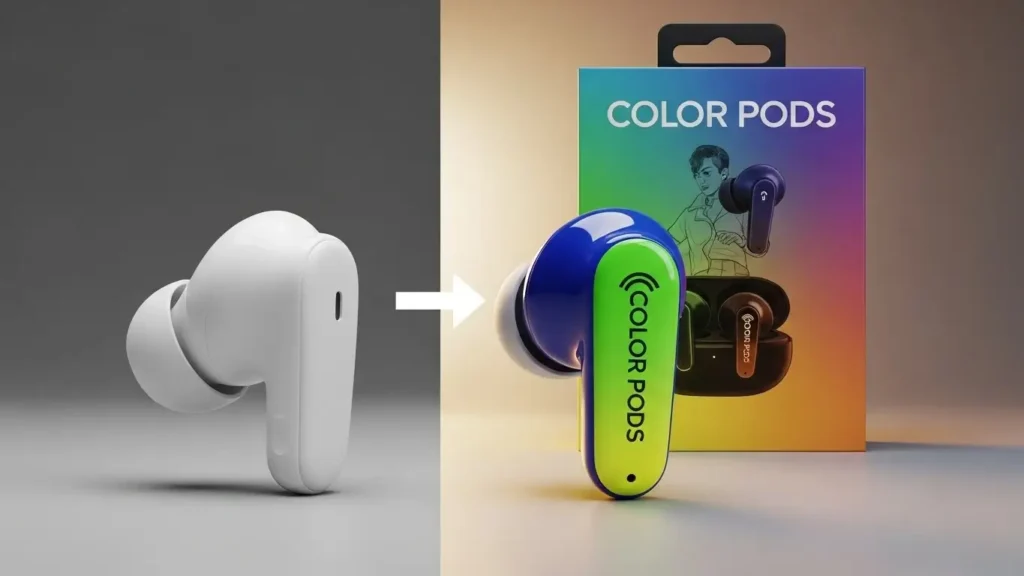
White labeling is the practice of taking a generic product (often from a manufacturer in China or locally) and applying your own branding, logo, and packaging to it. This is a massive leap forward because, for the first time, you are in control of the brand identity.
A prime example from my experience was “Color Pods.” We took generic electronic wireless earbuds, a product with high demand, and branded them as “Color Pods,” offering them in a variety of vibrant colors that established brands didn’t offer. We invested in stock, created a beautiful brand aesthetic, and marketed it as our own.
The Strategic Shift in a Shopify Business in 2026
In 2026, customers are savvy. They can spot a generic drop-shipped item a mile away. White labeling allows you to build perceived value. You are no longer competing on price alone; you are competing on brand identity. This stage forces you to learn three sophisticated business skills:
1. Branding (The “Why”)
Brand identity extends far beyond simple logos and color choices. It is about understanding your customer avatar deeply. Who are they? Why do they buy? In the White Label stage, you learn to craft a narrative. You are not just selling headphones; you are selling a lifestyle, a look or a feeling. This is the seed of a sellable e-commerce asset.
2. Negotiation
As your volume increases, you begin dealing with manufacturers directly to put your logo on products. This requires negotiation. You will learn how to haggle for better unit prices, lower Minimum Order Quantities (MOQs), and better payment terms.
In a Shopify business in 2026, your profit margin is made in the buying, not just the selling. Every cent you save on the unit cost contributes directly to your bottom line.
3. Forecasting
This skill is what distinguishes beginners from experts. Because you are branding the product, you are the only one selling it. You cannot just “buy more” from a local distributor instantly. You have to order stock months in advance.
- If you buy too much, you burn cash on dead stock.
- If you buy too little, you sell out, lose momentum, and disappoint customers. You must learn to look at your sales data and predict the future. You need to forecast 3 to 6 months out to ensure your supply chain remains unbroken.
The “Moat” Problem
White labeling is fantastic. It gives you higher margins and control over the look and feel. However, it still has a vulnerability that prevents it from being the ultimate sellable e-commerce asset: There is no Moat.
A “moat” is a defensive barrier around yourbusiness. In white labeling, you don’t own the intellectual property or the unique formulation of the product. Anyone else can go to the same supplier on Alibaba, buy the same earbuds, and slap a different logo on them. You have a brand, but you don’t have a unique product.
To create true wealth, wealth that leads to a massive exit, you must dig a moat. You must move from slapping a label on a product to creating a product that only you can sell.
This requires a dip in cash flow to fund research and development, but it sets the stage for the hockey-stick growth we desire. This leads us to the most lucrative transition of all: Stage 4, Building Your Own Product.
Stage 4: Own Product (The “Innovation” Phase)
We have now reached the turning point. This is where the amateurs are separated from the empire builders. In the graph of e-commerce growth, Stage 4 is often where you see a temporary dip in cash flow, but do not be alarmed. This is the strategic pullback before the exponential leap.
To build a thriving Shopify business in 2026, you must eventually transition from selling other people’s goods to creating your own. This is the Own Product stage.
In my journey, this transition happened with a product called Dose, an instant liquid coffee. Unlike the white-labeled headphones, Dose was not something I could just buy off the shelf in China. It was our own formulation, our own blend, and our own proprietary manufacturing method. No one else had it. This exclusivity creates the ultimate competitive advantage: a “moat” that protects your business from copycats.
However, developing a proprietary product requires heavy investment. You are spending money on development before you sell a single unit. This is why cash reserves often dip here. But if you have mastered the skills from the previous stages (traffic, logistics, branding), this investment creates a truly sellable e-commerce asset.
The 3 Advanced Skills of Stage 4
1. Research and Development (R&D): You are now an inventor. I had no idea how to make liquid coffee when I started. I had to learn how to source the right beans, find manufacturers willing to work with our custom formula, and source specific bottles and lids. R&D is complex and costly, but it is the only way to own your market in a Shopify business in 2026.
2. Unit Economics: This is the most critical financial skill you will learn. When you manufacture 10,000 bottles, 10,000 labels, and 10,000 lids, you must know the cost of every single component down to the penny. You need to understand your Cost of Goods Sold (COGS), your Customer Acquisition Cost (CAC), and your Gross Margin. If your unit economics are broken, you cannot scale. A sellable e-commerce asset must demonstrate healthy, predictable unit economics to a potential buyer.
3. Legal and Compliance: As you grow, the stakes get higher. You are no longer flying under the radar. You need to ensure your intellectual property is protected, your insurance is in order, and your contracts with suppliers are watertight. Buyers in 2026 will scrutinize your legal standing during due diligence. If your “Ts” aren’t crossed, the deal falls through.

Stage 5: Brand Building (The “Exit” Phase)
This is the summit. The final destination. At Stage 5, your mindset shifts completely. You are no longer building a business just to generate cash flow for your lifestyle; you are building an entity to be sold. You are polishing a diamond.
Investors and aggregators do not buy products; they buy brands. They want a turnkey operation they can plug into their existing portfolio. To transform your Shopify business in 2026 into a highly sellable e-commerce asset, you must detach yourself from the daily operations and treat the business as a standalone product.
The Final Trio of Skills
1. Building a Team: You cannot sell a business that depends entirely on you. If you get hit by a bus and the business stops, it is worth nothing. In Stage 5, you learn to hire “A-Players.” You build a management team that handles marketing, logistics, and operations. When a buyer looks at your company, they want to see a machine that runs smoothly without the founder’s constant intervention.
2. Expansion Strategy A Sellable E-Commerce Asset: A buyer wants to know that they can take what you built and double it. This involves proving the concept in new markets. If you are selling only in the US, can you expand to the UK or Australia? If you are only on Shopify, can you expand to Amazon, eBay or physical retail? You need to show the path to scale.
3. Valuation: Finally, you must understand what your business is worth. Valuation is usually a multiple of your profit (EBITDA). By understanding how businesses are valued, you can make strategic decisions to increase that multiple. You structure your books and your operations specifically to maximize that final sale price.

Conclusion: Your Journey to the Exit
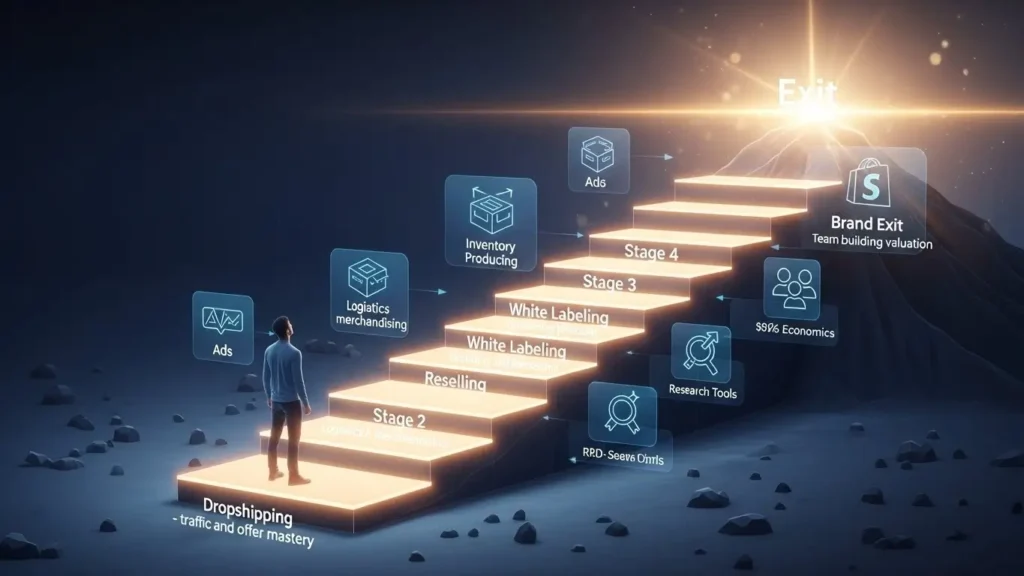
The path to building a Shopify business in 2026 is not a straight line. It is a stair-step evolution of skills.
- Stage 1: You learn Traffic and Offers (Dropshipping).
- Stage 2: You learn Logistics and Merchandising (Reselling).
- Stage 3: You learn Branding and Forecasting (White Labeling).
- Stage 4: You learn R&D and Economics (Own Product).
- Stage 5: You learn Team Building and Valuation (Brand Exit).
Most entrepreneurs get stuck at the early stages because they chase quick cash rather than skill acquisition. But if you keep your eyes on the horizon, focusing on building a sellable e-commerce asset, you can move from a side hustle to a life-changing exit.
Wherever you are on this curve, the next step is simply to master the skills of your current stage so you can graduate to the next.
(FAQs):
Q1: Is it still possible to start a Shopify business in 2026 using drop shipping?
A: Yes, absolutely. However, it should be viewed as an entry-level “learning phase” rather than a long-term business model. It is the best way to learn traffic and offer creation without risking capital on stock, but to build a sellable e-commerce asset, you must eventually move to owning your inventory and brand.
Q2: How much money do I need to move from Stage 2 (Reselling) to Stage 3 (White Labeling)?
A: This depends on the product, but you will need enough capital to cover the Minimum Order Quantity (MOQ) required by manufacturers. White labeling requires better cash flow management because you must pay for inventory upfront, unlike drop shipping.
Q3: Why is “Unit Economics” so important for a sellable E-Commerce asset?
A: Investors buy businesses based on math, not feelings. If you cannot prove that every unit you sell makes a specific profit after marketing and manufacturing costs, a buyer will not touch your business. Clear unit economics prove the business is sustainable and scalable.
Q4: Can I skip directly to Stage 4 (Own Product)?
A: It is possible, but risky. Without the skills learned in earlier stages, like driving traffic, logistics, and branding, you risk investing heavily in a product you don’t know how to sell. The “stair-step” approach minimizes risk by letting you learn on cheaper models first.
Q5: What makes a Shopify business a “sellable asset”?
A: A sellable asset is a business that does not rely on the owner to operate. It has its own brand, proprietary products (a moat), a team in place, and clean financial records. It is a turnkey operation that generates profit independently.