

Ready to enter the trillion-dollar AI economy? This in-depth guide reveals the exact blueprint used by successful founders to build a profitable ai consulting firm, including the strategies that generated over $230,000 in a single month. We break down the crucial 5-step framework from mastering the diagnostic audit approach to systematizing your service delivery and provide a clear 30-day action plan for securing your first paid client. Stop chasing every new tool and start building authority, trust and unstoppable revenue with this comprehensive strategy.
The market appetite is undeniable. Global giants like Accenture have booked over $600 million in ai consulting revenue in a single quarter, proving that businesses are desperate for guidance. However, you don’t need to be a multinational corporation to slice off a piece of this pie. Whether you are a solo freelancer or building a team, the core principle remains the same: businesses are drowning in inefficiency and they are willing to pay a premium for clarity.
This comprehensive guide breaks down the exact strategies, wins and pitfalls Nate encountered, offering a blueprint for starting an ai consulting firm and replicating this success, especially when launching an ai automation agency. We will define the role, explore the core revenue models, and dissect the two main paths to profitability.
What Exactly is an AI Consultant?
Before you print business cards or build a website, you must define what you are actually selling. A common misconception is that an AI consultant must be a coding wizard or a machine learning engineer. This is false when starting an ai consulting firm.
At its core, an ai consultant for small business is simply someone who, upon starting an ai consulting firm, leverages their knowledge of ai tools to solve a specific problem. You are not just selling technology; you are selling an outcome time saved, money made or operations systematized.
Think of it this way: How to become an ai consultant isn’t about learning how to build the medicine; it’s about knowing how to prescribe it. You are taking the “doctor approach” rather than the “pharmacist approach.” A pharmacist hands over a prescription that is already written. A doctor diagnoses the symptoms, understands the root cause and then prescribes the solution.
When a business owner says, “I know I need AI, but I don’t know where to start,” they don’t need a Python script; they need a roadmap. They need someone who is adept at starting an ai consulting firm to look at their messy sales process or their chaotic customer support and say, “Small business ai solutions are available, and here is exactly how we fix this.” If you can bridge the gap between their pain points and available AI solutions, you have a viable business.

The Revenue Breakdown: How to Make Money
Nate’s $231,000 month wasn’t a lump sum from one source. It was a diversified mix of income streams that every aspiring ai automation agency owner should understand. His revenue came from three distinct buckets:
- Educational Communities (B2C): Teaching freelancers and beginners how to build with ai.
- Consulting Projects (B2B): Diagnosing business problems and designing roadmaps.
- Implementation Work (B2B): Actually building and delivering the automation systems.
This hybrid model highlights a critical strategic decision you will face early on: Who do you serve? Broadly, the opportunities split into two main paths: Business-to-Consumer (B2C) and Business-to-Business (B2B).

Path 1: B2C – Educating the Market
The first path is the “Education Route.” This is where you master a specific tool like Make.com, ChatGPT, or n8n and teach others how to use it. This model relies on content and community.
For Nate, this was the primary driver of his massive revenue month. By creating YouTube videos and hosting a Skool community, he attracted thousands of people who wanted to learn. The beauty of the B2C model is scalability. You build a course or a community once and you can sell it to thousands of people.
However, a common pitfall here is thinking you need a massive following to start. You don’t. In fact, the best ai tools for small business owners often start gaining traction with very small, niche audiences. People aren’t paying for your fame; they are paying for your clarity. They want a shortcut. If you are just two steps ahead of them, you are qualified to lead when starting an ai consulting firm.
Nate discovered that his best way to learn was to teach. By documenting his own learning journey publicly, he built authority. When he shared a tutorial on Youtube channel how to automate a workflow, he wasn’t just helping others; he was creating a portfolio that proved his expertise for starting an ai consulting firm. This “document, don’t create” mindset is a proven win for beginners. It removes the pressure of being an “expert” and positions you as a relatable guide.

Path 2: B2B – High-Ticket Implementation
The second path is working directly with companies. This is the traditional consulting route. It is high-ticket, low-volume and deeply relational.
In this model, you are not selling a $500 course; you are selling AI consulting services for small businesses that can range from $3,000 to $50,000 per project. The value proposition here is different. You aren’t selling “learning”; you are selling “results.”
For example, a company might be losing 50% of its inbound leads because their sales team is too slow to follow up. If you can come in and implement an ai automation for small business that instantly texts leads and books appointments, you have directly impacted their bottom line. If your system saves them $100,000 a year, charging $10,000 for it is a no-brainer.
This path requires a “diagnostic” mindset. You must dive into their Standard Operating Procedures (SOPs), identify bottlenecks and design a custom ai implementation for small business workflows. The win here is immediate cash flow. You don’t need an audience of 10,000 subscribers to get a client. You just need to solve one expensive problem for one business owner when starting an ai consulting firm.

Scale vs. Simplicity: Which Path is Right for You?
When starting an ai consulting firm, the initial decision of whether to pursue B2C or B2B can seem daunting. The article provides an exceptional clarity on the trade-offs, summarized by a simple question: Do you want scale or immediate cash flow?
| Factor | B2C (Education) | B2B (Consulting/Agency) |
| Primary Goal | Leverage and Audience Building | Immediate Cash Flow and Proof of Concept |
| Time to Start | Slower (requires content and trust building) | Faster (close a $3k–$10k project in a week) |
| Monetization | Info products, courses, communities | High-ticket projects, monthly retainers |
| Key Win | Scalability (one-to-many impact) | Simplicity (solve one expensive problem well) |
If your goal is building systems that generate revenue while you sleep courses, communities and digital products then B2C is your path. It grants you maximum leverage but demands patience and consistent content creation to build authority. This is often the long game for a successful ai automation agency.
However, if your priority is immediate cash flow and building a portfolio of real-world results, B2B is the clear winner. You don’t need a fancy funnel or a large audience to start. You simply need to identify an expensive business problem and solve it effectively. How to start an AI consulting business quickly often means landing one or two high-value B2B projects that provide the foundational revenue and the critical case studies needed for later scaling for your firm in the process of starting an ai consulting firm.

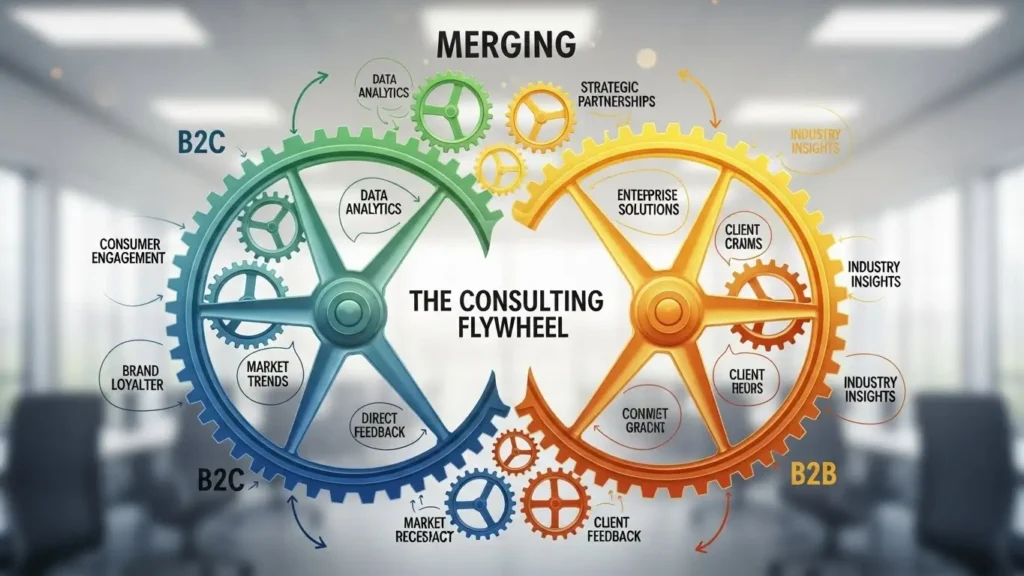
The Consulting Flywheel: Merging B2C and B2B Success
The true power in starting an ai consulting firm is realizing that B2C and B2B are not competing paths; they are complementary forces in a self-reinforcing flywheel.
Nate’s initial success was B2B-driven. He took on client projects, built custom systems and generated tangible results (hours saved, costs cut). This work produced two invaluable assets:
- Proof and Testimonials: Unshakeable evidence that he could solve real business problems.
- Expertise: Deep, real-world knowledge that can’t be gained from textbooks.
This B2B ai implementation for small business then became the foundation for his B2C content. The case studies and experiences he gained made his YouTube videos and courses authentic and authoritative. As his B2C audience grew, it began to feed a steady stream of highly qualified, inbound leads directly back into his B2B consulting pipeline.
This “Consulting Flywheel” is the ultimate mechanism for How to scale ai consulting firm. It allows you to maximize leverage while maintaining high-ticket revenue, ensuring that every project you complete strengthens your educational platform and every piece of content you create generates a potential client.
The 5-Step Framework for Success
Regardless of whether you start with education (B2C) or implementation (B2B), replicating Nate’s success in starting an ai consulting firm requires adherence to a specific, non-technical framework. This framework shifts your mindset from a builder to a trusted business partner.
1. The Golden Rule: Focus on Problems, Not Tools (The Diagnostic Win)
This is the biggest mindset shift required for success. Most business owners are focused on what they should use (e.g., “Should I use ChatGPT?”). You must focus on why they are struggling (e.g., “Why are my inbound leads dropping?”).
Your role is to lead with the pain point: wasted time, wasted money or lack of clarity. AI strategy for small business owners begins with a thorough ai audit for small business operations. You are diagnosing, not immediately prescribing.
Sometimes, the best solution isn’t a complex custom AI build; it might be integrating a simple existing SaaS product or automating a mundane task with a basic connector. Delivering this “minimum viable value” still provides massive leverage and builds trust. When you think like a problem solver instead of an “AI Automator,” opportunities appear everywhere, which is the foundational mindset for successfully starting an ai consulting firm. This foundational approach is crucial for establishing authority and trust.

2. Master Your Leverage: Learn One Tool Deeply
It is impossible to master the entire ai consulting tools list. The pitfall here is chasing every new release. Depth builds authority far more effectively than breadth.
For Nate, that tool was n8n (or N8N). He spent months mastering it until he was recognized as the local expert. Pick one platform whether it’s an automation platform like Make, a coding environment like Python/LangChain, or a specific generative ai consultant small business stack and go deep.
Being known as “the person who solves X problem using Y tool” means you can charge a premium. Why pay for a generalist when you can hire a specialist? You don’t need a huge following; you need unshakeable expertise in a focused domain. This is how a ChatGPT consulting for small business specialist or a machine learning consultant for small business can command a high fee with minimal initial outreach when starting an ai consulting firm.

3. Your Digital Resume: Documenting Everything Publicly
Trust is the single biggest currency in the consulting world. The most efficient way to build trust is to openly document your journey, whether you are starting an ai consulting firm or just freelancing.
Documenting is not the same as creating highly polished content. It means sharing:
- Your small builds and automations.
- Before-and-after results for projects.
- Failures, lessons learned and breakthroughs.
This transparency makes you relatable and builds authority faster than any cold email campaign. Your public documentation be it on LinkedIn, YouTube or X becomes your “digital resume” and portfolio. When inbound clients reach out, they already know and trust your expertise because they’ve seen the results in action. This is the ultimate method for how to get clients for ai consulting without resorting to hard selling.

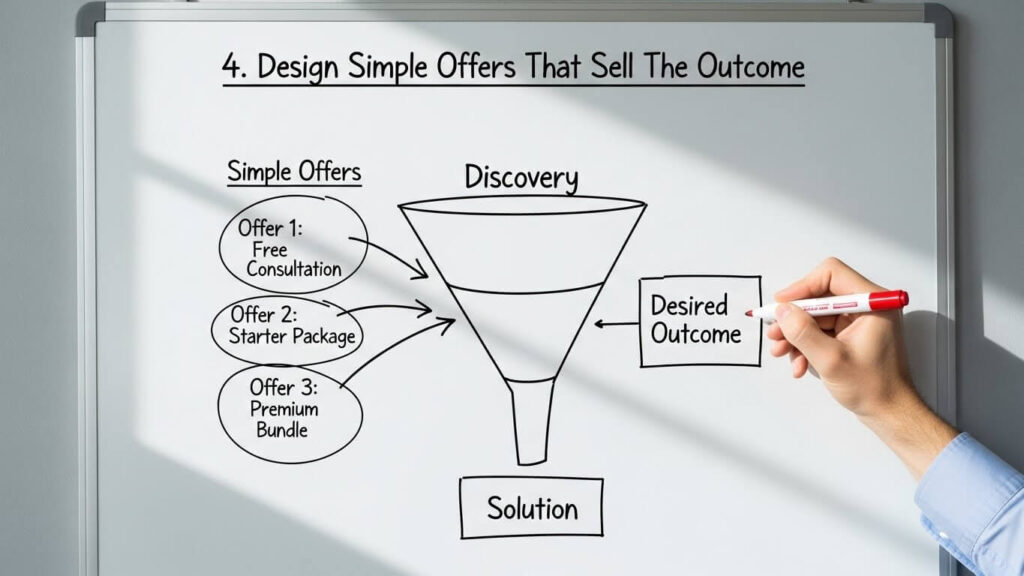
4. Design Simple Offers That Sell The Outcome
Complexity kills sales. A potential client must instantly understand the value proposition. Your offers must be clear, easy to understand and easy to buy.
Pitfall 2: Over-Complicated Pricing. Charging based on hours or complexity makes the client nervous. Instead, anchor your ai consulting pricing and your ai consultant hourly rate off of the value delivered.
- For B2C (An offer might be): “Learn how to build 3 critical automations in 7 days.”
- For B2B (An offer might be): “We will audit your sales process and identify $5,000 in potential time savings for $500.”
The client instantly grasps the value. To how to sell AI solutions to small business, you must make the ROI a “no-brainer” when starting an ai consulting firm. A good rule of thumb is ensuring the business owner achieves a 10x return on their investment within the first year of implementation.
5. Overdeliver, Systematize and Build Momentum
The final step of the framework is where you transition from being a skilled freelancer to the founder of a legitimate start ai consulting company. Every single client, whether they purchase an inexpensive course or a high-ticket B2B package, is an opportunity to generate proof.
Overdeliver: Go above and beyond in your initial projects. Your first few builds are not about maximizing profit; they are about collecting “reps,” real-world experience and undeniable results. When you overdeliver, you secure powerful testimonials, glowing referrals and definitive case studies.
Systematize: Once you achieve consistent results, turn your process into a system. How do you onboard a new client? How do you conduct the initial ai audit for small business? How do you deliver the final ai implementation for small business? Building robust systems from the initial lead to the final invoice ensures quality control, allows you to easily delegate tasks and forms the core of your ai consulting business plan. The faster you can move from idea to test to feedback to improvement, the faster your firm will grow.
These systems are what ultimately drive profitability. For a successful ai automation agency, repeatability is paramount when starting an ai consulting firm. A systematized onboarding process, for instance, means less wasted time and a higher capacity for taking on new clients seeking ai process automation consulting. This compounding effect of proof, confidence and systemization fuels the B2C education side and allows you to command higher rates in B2B.

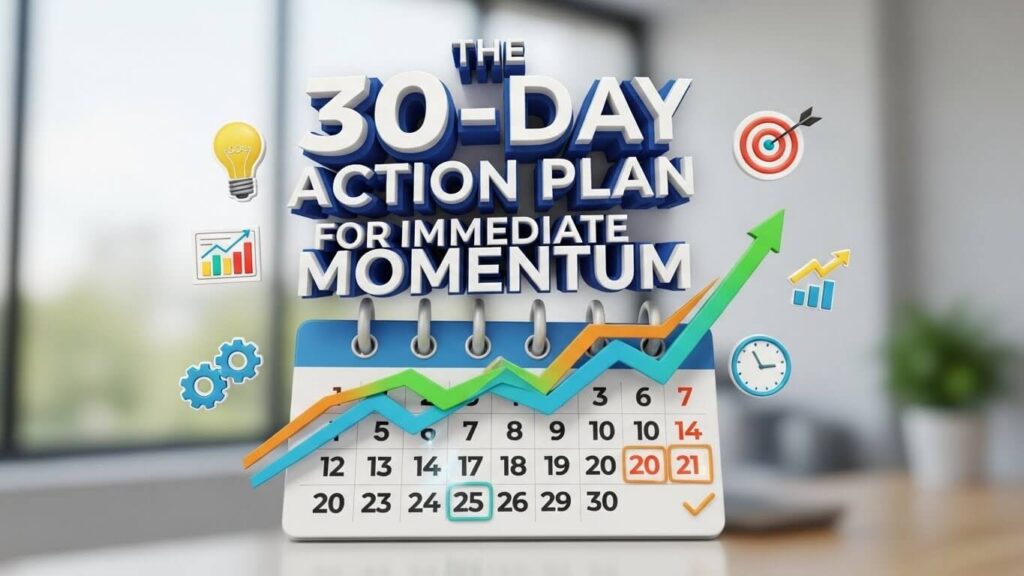
The 30-Day Action Plan for Immediate Momentum
If you are ready to stop planning and start building, this 30-day framework, drawn directly from the experience of successful consultants, provides the necessary momentum to launch your firm and secure your first paid client. This action plan is the practical starting point for starting an ai consulting firm today.
Days 1–3: Pick Your Niche Wisely
Choosing the right niche is non-negotiable. Don’t chase huge, highly regulated industries like healthcare or finance initially. Focus on verticals that have two key characteristics:
- High Repeatable Manual Tasks: Industries like real estate, e-commerce, coaching or marketing agencies. These fields have numerous administrative and communication tasks ripe for automation.
- Existing Connections: Start where you have an existing network, even if it’s small. Trust is easier to build with a warm lead.
By targeting niches with low regulatory barriers and clear bottlenecks, you accelerate the path to a quick win. This specialized focus also makes it easier to position yourself as an expert. For instance, being the “ai implementation expert for mortgage brokers” is far more powerful than being a generalist ai consultant.
Days 3–10: Deep Market Research and Problem Discovery
Spend this week obsessively studying your chosen niche. Your goal is to speak the client’s language and understand their problems better than they do themselves.
- Go Deep: Scour industry-specific Reddit threads, LinkedIn posts and professional forums.
- Talk to People: Have five honest conversations with people in your niche. Ask them: “What is the single most annoying or time-consuming task you do every week?”
- Identify Bottlenecks: Use these insights to uncover three clear, expensive problems worth solving. This focused research prepares you to offer genuinely valuable ai consulting for small business and prevents you from offering solutions to problems that don’t exist.
Days 10–20: The Win-Win Audit to Client Conversion
With your target niche and their pain points defined, start offering free ai automation audits. This is your primary market research and credibility builder, disguised as free value.
- The Offer: Reach out and say, “I specialize in [Your Niche] and can audit your sales process to show you exactly where ai training for small business owners can save you 10 hours a week.”
- The Goal: This is not about selling. It’s about building trust and demonstrating expertise. You are identifying inefficiencies, detailing clear small business ai solutions and showcasing that you understand their operations.
- The Conversion: Naturally, some businesses will ask, “Can you just build that for us?” This is your first paid project. Even if the price is low, overdeliver. These early contracts for ai chatbot implementation for SMB or ai consulting for customer service small business provide the crucial proof needed for the next phase.
Days 20–30: Case Studies as Your New Inbound Engine
Dedicate the final 10 days to leveraging your initial project wins.
- Track Everything: Meticulously record the “before and after” metrics hours saved, revenue gained, cost reduced or lead speed improved.
- Create Content: Turn these metrics into detailed case studies and public-facing content. Post your results, process and takeaways on the platforms where your target clients spend time.
- Build Authority: This content acts as a testimonial amplifier, attracting inbound leads who say, “They did that for X business; I want them to do it for mine.” This is the continuous feedback loop that powers your firm’s growth.
By following this action plan, you establish the three essential ingredients for scale: proof, confidence and momentum.
Conclusion: Your Blueprint for Starting an AI Consulting Firm
The opportunity presented by the ai revolution is not just for software engineers; it is for problem solvers and strategists. The true leverage in the market lies in translating the complex language of machine learning into clear, profitable outcomes for clients. Whether you choose the scale of B2C education or the immediate cash flow of B2B high-ticket implementation, the paths are interconnected.
By prioritizing problem diagnosis, mastering a single leverage tool, documenting your wins publicly and designing offers anchored to ROI, you transition from someone exploring how to start an ai consulting business to a proven industry authority. This definitive guide, built on experience, expertise and trust, provides your comprehensive ai consulting business plan for starting an ai consulting firm. Start today by picking your niche, learning their problems, and turning free audits into high-value case studies.
FAQs:
Q1: What is a reasonable fee structure for a beginner AI consultant?
A: When setting your ai consulting pricing or ai consultant hourly rate, the initial focus should be on value delivered, not hours spent. For B2B projects, anchor the price at 10-20% of the value you deliver in the first year. For instance, if your automation is projected to save the client $30,000 annually, charging $3,000 to $6,000for the project is a “no-brainer” for them and is crucial for successfully starting an ai consulting firm. You can offer a lower initial project rate to build your portfolio and quickly raise your rates once you have three strong case studies proving ROI.
Q2: Should I focus on Machine Learning or Generative AI when I first launch my firm?
A:Unless you are targeting large enterprises, focus on generative ai consultant small business and practical automation. Tasks like using ChatGPT consulting for small business for content generation or setting up simple automations with no-code tools, provide immediate, visible ROI. Becoming a machine learning consultant for small business requires highly specialized technical skill sets and often targets more complex, data-heavy problems that are typically priced higher and involve longer sales cycles. Start simple and scale the complexity later when starting an ai consulting firm.
Q3: What are the key elements of B2B AI Consulting for SMBs?
A: Successful B2B ai consulting for SMBs focuses on three things:
- AI Audit: Identifying workflow bottlenecks and quantifying the associated costs.
- Implementation: Delivering small business ai solutions that immediately address those bottlenecks. This includes systems like ai chatbot implementation for SMB.
- Enablement: Providing clear Offer GenAI services to small businesses and ensuring team adoption. You must teach the business owner how to sell ai solutions to small business to their own internal stakeholders.
Q4: Are AI consulting courses necessary to start?
A: While experience from client projects (B2B) is the best teacher, specialized ai consulting courses can provide structure and accelerate your learning of specific tools or niche strategies. They are valuable for filling knowledge gaps, but they are not a prerequisite for securing your first client when starting an ai consulting firm. Use your initial projects as paid training and complement that experience with targeted courses.