

Stop asking will AI replace my job and start building your defense. This comprehensive article analyzes the distinction between “shallow” and “deep” expertise, revealing why certain highly paid jobs at risk from AI (like basic financial advising and law) are disappearing first. Get the 3-step blueprint mastering AI fluency, polymath skills, and personal branding to elevate your value from a replaceable task-doer to an irreplaceable strategic operator.
In just the first few months of this year, the global tech landscape has shifted definitively. Over 100,000 tech workers have been laid off from industry giants like Amazon, Intel, Microsoft, Meta, and Salesforce. Amazon alone cut 14,000 corporate roles. Klarna reduced its staff by nearly 40% specifically to lean into artificial intelligence. Duolingo is actively phasing out human contractors in favor of automation.
If you are reading this and asking, “Will AI replace my job?” you are not alone. This anxiety is no longer just a headline; it is a visible economic reality. In the UK, one in six employers now expects AI to reduce their workforce within the next year, with junior roles being the first to vanish. This article delves into the insights gathered from top Silicon Valley founders, investors, and CEOs to answer the burning question: Will AI replace my job, and more importantly, how can you pivot from “shallow” work to “deep” expertise to survive this transition?
The AI Paradox: Why the First Step of the Ladder is Cracking
We are currently witnessing a paradox in the corporate world. Companies are publicly stating, “If we don’t adopt AI, we won’t exist in 15 years.” Yet, simultaneously, they are hiring fewer junior employees than ever before. The traditional entry-level roles are the first step on the career ladder, and are cracking. This creates a terrifying uncertainty for recent graduates and mid-level professionals alike. If that first step is gone, what does the future of work look like?
The fear is valid. When discussing jobs at risk from AI, we often think of blue-collar automation, but the current wave is hitting white-collar cognitive labor. The question will AI replace my job is echoing through marketing departments, law firms, and coding bootcamps alike. The consensus among founders is stark: within five years, we may approach AGI (Artificial General Intelligence), potentially leading to massive structural unemployment for those who refuse to adapt.

School vs. Reality: The Industrial Education Trap
For decades, the “life formula” was simple: Go to school, get a degree, get a job. That formula is now broken. While education prices skyrocket, graduate job openings in some countries are down by 40%.
Why is this happening? According to Daniel Priestley, a renowned British entrepreneur, our schooling system is fundamentally rooted in the industrial age. We spend 12 to 15 years engaging in arduous training designed to prepare us for factories and offices that effectively no longer exist. The hard truth is that traditional education trains humans to act like “large language models” that are simply not as efficient as the current digital versions. We are taught to be functional, repetitive, and compliant.
“We trained you as a large language model that’s not as good as the current version… teaching people to do functional work that can be automated or outsourced way faster, way cheaper, way easier.”
In the West, the competition is twofold. You are not just asking whether AI will replace my job; you are competing against technology and against global talent armed with that same technology in countries with a significantly lower cost of living.

The New Definition of Competence
So, is the degree useless? Not entirely, but it is no longer a safety net. The question is no longer “Do I have a degree?” The real questions that determine if AI replaces my job are:
- Can I solve ambitious problems end-to-end employing AI tools?
- Can AI actually 10x my output?
- Can I do something beyond what a model and a cheaper freelancer could do together?
The era of being paid for “functional work” is ending. If your daily output consists of tasks that can be easily outsourced or automated, you are in the danger zone. To understand if AI replace my job, you must analyze the depth of your work. Are you providing unique strategic value, or are you simply executing a process?
As we move into the next section of this guide, we will analyze specifically which professions are on the chopping block. It is not always who you think. The nuance between “shallow” and “deep” expertise is the defining factor in whether jobs are at risk from AI include yours.

The Critical Distinction Between Shallow and Deep Expertise
The first step toward securing your future is understanding exactly which jobs at risk from AI are currently in the crosshairs. When most people ask, “Will AI replace my job?” they often expect to hear predictable answers like junior copywriters, basic coders or graphic designers. However, the reality is far more nuanced and in some ways, more unsettling. The threat is not focused on the profession itself, but on the execution of the job.
Financial Advisors, Lawyers, and Agents: The Digital Blitz
AI is targeting highly paid professions that rely on aggregating and synthesizing publicly available data. For instance, consider the financial advisor. If an advisor’s primary value is selecting mutual funds from a list or simply picking stocks based on commonly available analyst reports, their role is already functionally obsolete. Advanced models like Perplexity can now read every analyst report, analyze morning news, understand the impact on a specific portfolio, and even suggest what a figure like Warren Buffett would do in the same situation. No single human advisor can match this speed or breadth of knowledge.
The same applies to real estate brokers. If an agent’s job description is limited to showing you listings found on Zillow or Redfin, their value is zero. A simple automated agent can monitor new listings below a certain budget in a specific neighborhood, send push notifications, and even submit visit applications on your behalf. But here is where the critical distinction emerges, answering the core question: Will AI replace my job?
The Shallow vs. Deep Pattern
AI is not killing entire professions; it is killing the shallow version of those professions.
| Shallow Expertise (At Risk) | Deep Expertise (Future-Proof) |
| Lawyer: Rewriting standard templates or performing basic document review. | Financial Advisor: Securing access to off-market deals, private equity, venture capital, or hedge funds unavailable to the public. |
| Financial Advisor: Picking mutual funds or analyzing public stock data. | Real Estate Agent: Finding off-market properties, navigating complex human/legal situations, and strategically bidding. |
| Real Estate Agent: Sending links found on public sites (Zillow, Redfin). | Real Estate Agent: Finding off-market properties, navigating complex human/legal situations and strategically bidding. |
The pattern is undeniable. If your job relies solely on codified knowledge, that is, information and processes that exist on the web and can be easily Googled, your expertise is shallow and highly automatable. The true value of a human and the reason you will always have a job comes from the un-Googleable elements:
- Motivation and Empathy: The ability to provide emotional support and encouragement, especially in high-stakes situations (like the non-profit helping students apply to college).
- Access and Trust: Gaining entry to exclusive funds, off-market deals, and navigating messy human conflicts.
- Judgment and Strategy: Knowing when to deviate from the template and how to synthesize conflicting data into a winning strategy.
If you are concerned about your role, ask yourself: Can an AI system, combined with a cheap freelancer, replicate 80% of my weekly output? If the answer is yes, then your job as currently defined is one of the jobs at risk from AI.
Beyond the W-2: Building Your Own Path
As AI shrinks the number of basic, repetitive white-collar roles, more and more smart individuals are choosing to bypass the shrinking roles altogether. Instead of fighting for one of the dwindling junior positions, the answer to, will AI replace my job? For many is to build their own things: a startup, a service, or a strong personal brand. This fundamental shift from being a cog in a machine to being an independent operator requires a clean digital presence. Whether you’re launching an AI service or a personal consultancy, you need a home where your work lives, a website that both customers and their AI assistants can easily find.
In an increasingly crowded digital world where finding a clean .com domain is nearly impossible, new options are essential. Domains like .online offer a clean, professional, and universal digital home for freelancers, creators, and AI startups alike. This pivot to self-reliance is not just a side hustle; it’s becoming a primary defense mechanism against the question, will AI replace my job? By owning your platform and clientele, you control the terms of your work, making you far less susceptible to corporate layoff waves driven by automation.

The Blueprint for an AI-Proof Career
If you already hold a good, interesting job, the shift toward automation can feel like an immediate threat. You see the changes happening within your company and naturally wonder, will AI replace my job? The answer from top company leaders is clear: your survival depends entirely on your willingness to elevate your work.
The New Contract at Work: Elevate or Exit
The consensus among executives is that there is always higher-value work to be done. While AI may replace the “repetitive, functional, annoying, frustrating jobs,” it simultaneously opens up opportunities to address previously unserved markets or tackle larger, more complex challenges.
This is the new contract of work: AI takes the boring, repeatable tasks; the human moves up to higher-value problems. If an employee refuses to move up, they eventually move out. Big tech CEOs are now operating under the belief that if employees refuse to use AI, the company is no longer set up for success because competitors are mandating its use. This transition phase forces employees to become partners with the technology. Your number one goal is simple: Become the person who knows how to do your job with AI, not despite it.
The Practical Exercise: Building AI Fluency
To secure your position and prove that the answer to will AI replace my job is “no,” start with a practical exercise.
- Identify Repetitive Tasks: Ask yourself, what are the three most repetitive things I do every week? (e.g., writing emails, making reports, cleaning data, conducting basic research).
- Build Tiny AI Workflows: Build a small automation or set of sophisticated prompts around each one using tools like ChatGPT, Claude, or Perplexity. For example, use a dedicated space in a tool like Perplexity to organize research for a recurring project.
- Measure and Delegate: Notice how you can save 30% to 50% of your time on that repetitive work. Then, constantly ask: What higher-level work can I move to? Where is the highest ROI? Where should I invest more time, and where should I delegate to AI?
This process transforms you from a replaceable task doer to an irreplaceable operator who leverages technology to move the business forward. Documenting this shift is crucial: having a line on your CV like, “Reduced weekly X task by 50% using custom AI workflows,” is the language hiring managers truly understand when evaluating jobs at risk from AI.
The Most In-Demand Skills: Becoming a Polymath
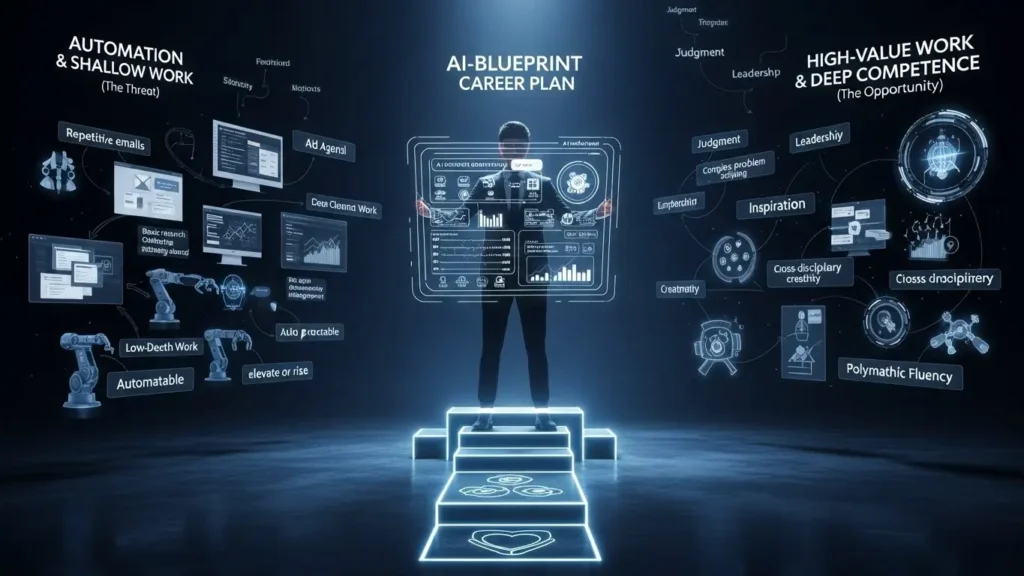
As AI handles the functional execution, the future will demand a return to the “polymath,” the multi-disciplinary individual epitomized by Leonardo da Vinci. The new AI age wants you to be a Human Epoch, someone who brings the five abilities AI still struggles to replicate:
- Empathy and Presence: Reading the room, understanding a client’s hesitation, and offering emotional support.
- Opinion or Ethics: Making crucial judgment calls when data conflicts and defining moral boundaries.
- Creativity and Reframing: Re-framing a problem when the model’s answer is insufficient.
- Hope/Leadership: Inspiring a team and motivating them to move forward.
- Polymathic Fluency: The ability to connect dots across disparate fields (a marketer who codes, a doctor who understands AI).
This combination of human psychology plus AI fluency is the premium skill set of the future. Two people can use ChatGPT to write a report, but only one can walk into a meeting, read the room, make a judgment call, and inspire the team. This is the ultimate defense against the fear that AI replace my job.
Your Greatest Asset: The Personal Brand
In a world where AI can generate infinite, high-quality content, people follow people. Your personal brand will matter more than ever because personal brands get 20 times the cut-through as business brands when trying to get attention.
Entrepreneur Daniel Priestley uses the “fog” analogy: if you are already “up in the air” (with an established personal brand), you can keep flying. If you are still on the ground, the fog of AI-generated content makes it nearly impossible to take off. You don’t need millions of followers. You need a dedicated following of 2,000 to 20,000 people who know what you’re good at, like your way of thinking, and feel a parasocial relationship with you. This asset is invaluable. It is your strongest, most direct answer to the question: Will AI Replace My Job? Start posting once or twice a week about what you are learning, building, and improving. Document the journey and share real experiments.
The Cornerstone of Success: Learning to Learn
With all these advanced tools, the fundamental question remains: Do we even need formal education? As Perplexity CEO Aravind Srinivas noted about his PhD, the greatest thing he learned wasn’t the research itself, but the meta-skill of “learning to learn.” A good education, whether formal or self-directed, teaches:
- The willingness to seek truth and engage in relentless questioning.
- The ability to ask better questions (a skill that makes AI tools more effective).
- The discipline to go deep when everyone else is skimming.
AI makes accessing knowledge easier than ever. It does not replace your responsibility to actually use it, question it, and build depth.
Your 3-Step Plan to Become Irreplaceable
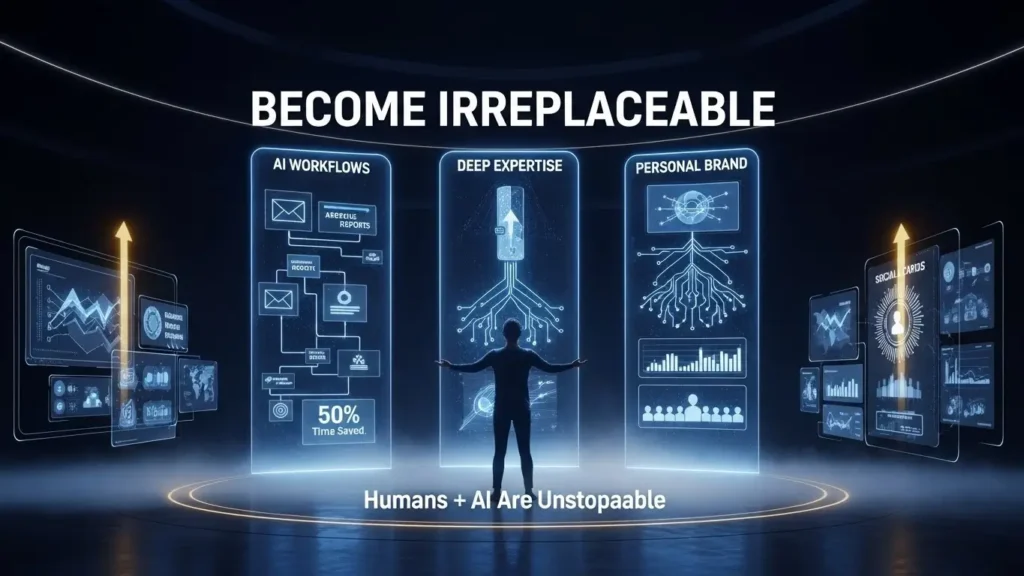
Yes, entry-level roles are disappearing, and simple, repeatable work is becoming less valuable. But the future is not humans versus AI; it is humans plus AI. The widening gap is between those who adapt and those who don’t. To ensure the answer to will AI replace my job is a confident “no,” here is the actionable plan you must start today:
- Learn to Work With AI, Not Around It: Cut the time in half for 3–5 repetitive tasks in the next 30 days using AI workflows (prompts, automations, agents). Put the results directly on your CV and LinkedIn.
- Go Deep in One Area, Then Expand: Commit to one year of uncomfortable depth in a core field. After that, add an adjacent skill (a designer who knows data, a marketer who codes). This makes you an operator who moves the business, not just a task doer.
- Build a Small but Real Personal Brand: Start documenting your insights and work on a platform like LinkedIn. Cultivate a following of a few thousand people who understand your unique expertise. This is your insurance policy against the uncertainty of jobs at risk from AI.
Your career is not over. It is just in beta, and you are the one shipping the next, AI-optimized version.
(FAQs):
1. Will AI replace my job if I am a creative professional, like a writer or designer?
AI is rapidly replacing the shallow version of creative work, template-based content, generic stock design, and basic copywriting. However, AI cannot replicate deep creativity, judgment, taste, or the ability to generate culturally resonant concepts. To ensure the answer to will AI replace my job is “no,” creative professionals must focus on strategy, emotional connection, and defining the initial creative vision (the what and the why), leaving the execution (the how) to the models.
2. What are the top jobs at risk from AI in the immediate future?
The jobs at risk from AI are primarily those that involve repetitive cognitive tasks, information synthesis, and data aggregation based on publicly available information. This includes, but is not limited to, basic financial analysis, entry-level coding (template writing), legal document review, customer service (generic inquiries), and real estate agents who only provide publicly listed links.
3. How can I use the E.E.A.T. framework to future-proof my career?
The E.E.A.T. (Experience, Expertise, Authority, Trustworthiness) framework is essential for careers in the AI age.
- Experience: Demonstrate how you use AI to achieve superior outcomes (show, don’t just tell).
- Expertise: Go deep in one area (polymath).
- Authority: Build a personal brand and become a thought leader in your niche.
- Trust: Focus on the human elements AI lacks: ethics, judgment, and building strong, trusting client relationships. These qualities will replace my job is irrelevant because your value is uniquely human.